- info@mteturkey.com
- +90 (312) 309 20 86
- +905492856945
English


Bushing Monitoring System
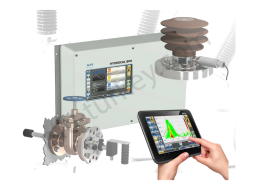
·HYDROCAL BPD is a modular online monitoring system for high voltage bushings as well as partial discharge of bushings and the active part of power transformers. Bushing monitoring supports both the measurement of voltage and phase angle on the test tap to derive tanδ/PF and bushing capacitance as well as electrical partial discharge measurement acc. IEC 60270. For the partial discharge analysis within the active part of high voltage power transformers UHF (ultra-high frequency) measurement is supported.
·HYDROCAL BPD can be combined with other HYDROCAL models, preferably HYDROCAL genX, in order to set up a comprehensive monitoring system.
As per CIGRÉ Working Group A2.37 bushings resp. the lead exit represent the 2nd largest group of transformer failure locations (approx. 25%) after the windings (43%) and before the tap changer (23%) therefore bushing monitoring can help to reduce those failures whereas UHF partial discharge analysis of the active part of a power transformer is an ideal combination with online DGA performed by the HYDROCAL product family.
The modular concept of HYDROCAL BPD allows the user to select the combination of bushing monitoring and partial discharge functions that suits best to its monitoring needs and technology convictions. Whereas the measurement of voltage and phase angle on the test tap of high voltage bushings allows to compare tanδ/PF with factory test results the partial discharge analysis could help to detect electrical failures of those bushings faster. UHF (ultra-high frequency) partial discharge analysis of the active part of large power transformers can be a good method to determine winding or other electrical failures without disturbances e.g. by corona.
·Transformer bushing failures sometimes occur outside the capacitive layers, where traditional analysis of leakage currents will not give indication of an internal problem.
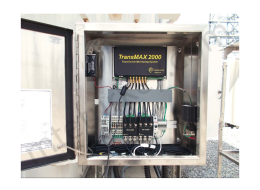
·When the utmost in transformer reliability is required for critical transformer assets, partial discharge detection must be part of the monitoring strategy. The TransMAX 2000 performs all the test methods of the ZVCM-1001 but also monitors for partial discharge (PD). The PD activity in the bushings is monitored in parallel with the power factor calculations.
·PD is detected using the same bushing sensor as with the ZVCM-1001, there are no other sensors or Rogowski coils.
·PD is caused by defective insulation in high-stress areas, movement of energized parts, or design errors where lowlevel discharges occur. Some types of PD may not present a problem, but others can develop into surface tracking or insulation failure, which can lead to bushing or transformer failure.
·The TransMAX 2000 also has the unique capability of monitoring GIC events and trends which potentially could damage the transformer.
·Easy-to-use MultiTool software works with both the TransMAX 2000 and ZVCM-1000.
Additional Specifications TransMAX 2000
·Power Supply Input Operating Range: 85-264 VAC, 120-370 VDC, 50 VA
·PD Frequency: HF <20 MHz
·PD Resolution: 1.0°
·Time Resolution: 10 nS
·Dynamic Range: 65 dB
·PD Intensity: 0 – 5000 mW
·PD Amplitude: 0.02 – 100 nC ± 10 V
·Top oil temperature sensor input
·Three load current CT sensor inputs
·Ambient Temperature and Humidity sensor inputs
·USB port for ZTZ software configuration, commissioning and data analysis
·RS-485 port for SCADA access
·Modbus RTU or DNP 3.0 Serial
·Ethernet port remote access via ZTZ Software, SCADA access over Modbus TCP or
·DNP over Ethernet Outputs
·PF, C1, leakage current for each bushing
·Imbalance for each group of 3 bushings
·PD power, PD amplitude, PD pulse count for each channel
·PRPD plots for each channel
·Top oil temperature
·Load currents
·Hot-Spot temperature
·Ambient temperature and humidity